
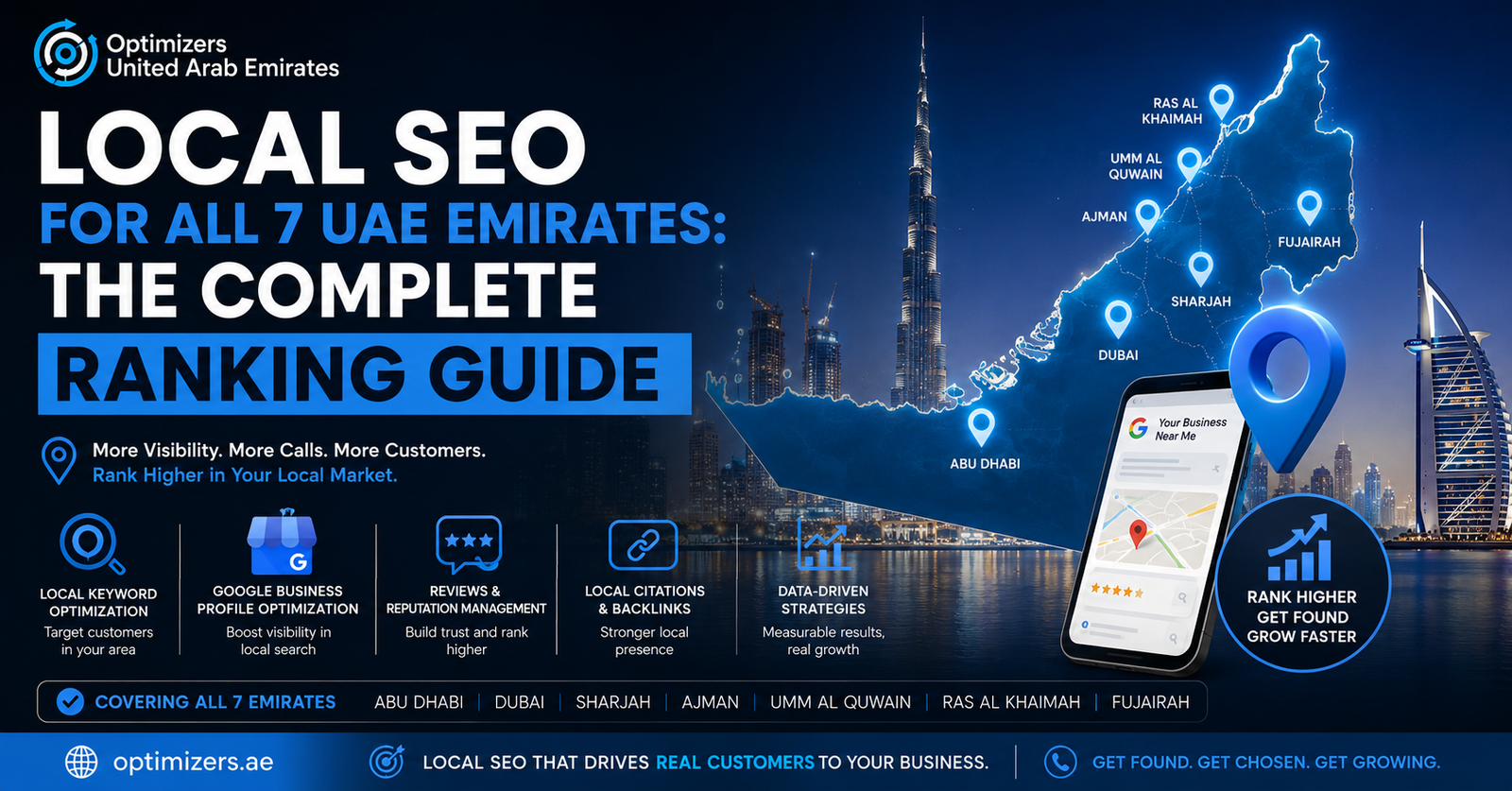
Local SEO for All 7 UAE Emirates: The Complete Ranking Guide
If your business shows up on page one in Dubai but disappears the moment someone searches from Sharjah or Abu Dhabi, you don’t have a UAE problem. You have a local SEO problem. Most guides treat “UAE SEO” as a synonym for “Dubai SEO” and stop there, leaving six emirates worth of customers undiscovered. This guide covers what it actually takes to rank in the Google Local Pack across all seven emirates Dubai, Abu Dhabi, Sharjah, Ajman, Umm Al Quwain, Ras Al Khaimah, and Fujairah from Google Business Profile setup to emirate-specific citation building, Arabic search behavior, and the mistakes that quietly cap how many local customers find you.
What is local SEO and why does it matter for UAE businesses?
Local SEO is the practice of optimizing your online presence so your business appears when people search for products or services near a specific location, rather than competing for purely national rankings. In the UAE, this means showing up in the Google Local Pack, Google Maps, and local organic results when someone searches “real estate agent Dubai Marina” or “dentist near me” from Sharjah.
Local intent drives a meaningful share of UAE search behavior. According to a 2026 UAE digital marketing benchmark report by Andava, 46% of Google searches in the UAE carry explicit local intent, and 76% of consumers visit a physical business within 24 hours of running a local search. Over 70% of UAE web traffic comes from mobile devices, where Google relies almost entirely on a site’s mobile version to decide rankings. Ignore local SEO and you are invisible at the exact moment a nearby customer is ready to buy.
How the Google Local Pack works in the UAE?
Google ranks local results using three factors: relevance, distance, and prominence. Relevance measures how well your business profile matches the search query. Distance measures how close your listed address is to the searcher or to the location named in the query. Prominence measures how well-known and trusted your business is, based on signals like reviews, citations, and backlinks.
This matters more in the UAE than in most markets because the emirates sit close together geographically, yet Google still treats them as distinct local markets. A roofing contractor based in Sharjah will rarely appear in Dubai’s Local Pack, even though the drive between the two cities takes twenty minutes. If your customers come from multiple emirates, you need a deliberate strategy for each one, not a single Dubai-focused profile and the hope that nearby searches spill over.
How AI is changing local search results in the UAE?
Google’s local results no longer stop at ten blue links and a map. BrightLocal’s 2026 Local Search Consumer Survey found that AI-powered local packs now appear in 84% of location-intent mobile queries, up from 67% in 2024. These AI-enhanced results pull directly from your Google Business Profile data, your reviews, and your website content to generate a summarized answer before a searcher ever clicks through.
This raises the bar on accuracy and structure. A profile with vague categories, outdated hours, or inconsistent address details gives the AI system less to work with, and it will favor a competitor’s cleaner data instead. Every section in this guide doubles as preparation for this shift: complete, accurate, well-structured local signals now feed both the traditional Local Pack and the AI layer sitting on top of it.
Your Google Business Profile: the foundation of UAE local SEO
Every local SEO strategy starts with a fully optimized Google Business Profile (GBP), formerly Google My Business. It is the single most important asset for appearing in the Local Pack, Maps, and Google’s AI-powered local results.
This raises the bar on accuracy and structure. A profile with vague categories, outdated hours, or inconsistent address details gives the AI system less to work with, and it will favor a competitor’s cleaner data instead. Every section in this guide doubles as preparation for this shift: complete, accurate, well-structured local signals now feed both the traditional Local Pack and the AI layer sitting on top of it.
Choosing the right primary and secondary categories
Your primary category is one of the strongest local ranking signals you control. A clinic should choose “Medical Clinic” rather than the broader “Healthcare,” and a web development agency should pick “Web Designer” rather than “Software Company.” Add secondary categories to capture adjacent searches a real estate brokerage might add “Property Management Company” alongside its primary “Real Estate Agency” category but only where the category genuinely describes what you do. Misleading categories trigger profile suspensions in tightly regulated UAE verticals like real estate, legal, and healthcare.
This raises the bar on accuracy and structure. A profile with vague categories, outdated hours, or inconsistent address details gives the AI system less to work with, and it will favor a competitor’s cleaner data instead. Every section in this guide doubles as preparation for this shift: complete, accurate, well-structured local signals now feed both the traditional Local Pack and the AI layer sitting on top of it.
Writing a profile description that converts
Your GBP description should state your primary service and location naturally within the first sentence, then explain what makes you different. Avoid keyword stuffing; Google and customers can both tell when a description exists only to repeat “best digital marketing agency in Dubai” five times. Mention Dubai, Abu Dhabi, or whichever emirate you serve once, clearly, and let the rest of the description build trust.
Photos, posts, and Q&A
Profiles with ten or more photos receive significantly more direction requests and website clicks than profiles with fewer. Post weekly updates about offers, new services, or completed projects an active profile signals to Google that the business is genuinely operating. Monitor and answer the Q&A section yourself; unanswered questions sitting on your profile for months are a visible trust signal in the wrong direction.
Local SEO emirate by emirate: the citation and directory guide
Citations consistent mentions of your business name, address, and phone number (NAP) across the web are one of Google’s clearest prominence signals. Most UAE businesses build citations on Dubai-focused directories and stop there, missing the emirate-specific listings that actually move rankings outside Dubai.
| Emirate | Strongest directories to prioritize | What makes it different |
|---|---|---|
| Dubai | Yellow Pages UAE, Dubizzle, Bayut, Zomato, 2GIS | The most competitive market in the UAE; neighborhood-level targeting (Marina, JLT, Business Bay) often matters more than emirate-level targeting |
| Abu Dhabi | Citysearch.ae, Yellow Pages UAE, Emirates Business Directory | Government and corporate-heavy audience; industrial and trade listings concentrate around Mussafah |
| Sharjah | Yellow Pages UAE, AllUAEOne, LocalSearch.ae | Lower citation competition than Dubai; strong opportunity for education and family-services SEO |
| Ajman | Yellow Pages UAE, Emirates Business Directory, List in UAE | Active construction and real estate citation opportunities tied to Ajman Free Zone |
| Ras Al Khaimah | Yellow Pages UAE, AllUAEOne | Fast-growing hospitality and tourism search demand around Mina Al Arab and Al Marjan Island |
| Fujairah | Yellow Pages UAE, LocalSearch.ae, Citysearch.ae | A port and logistics-driven economy; lower search volume but very low citation competition |
| Umm Al | Yellow Pages UAE | A port and logistics-driven economy; lower search volume but very low citation competition |
| Quwain | AllUAEOne | Emirate to dominate quickly |
Build a profile on each relevant directory using identical NAP details, then layer in two or three industry-specific platforms per emirate. Real estate businesses should add Bayut and Dubizzle, hospitality businesses should add Zomato and TripAdvisor, and IT or SaaS companies operating from a free zone should pursue zone-specific directories alongside the general ones above.
NAP consistency: the detail that quietly kills rankings
NAP consistency means your business name, address, and phone number appear identically everywhere they are listed online. A single inconsistency “Suite 204” on your website but “Office 204” on a directory, or an outdated phone number on an old listing confuses Google’s confidence in which business is real, which suppresses rankings even when every other signal is strong.
Audit your NAP quarterly. Search your business name alongside each emirate you operate in, check every result that surfaces, and correct discrepancies as you find them. This single habit resolves more local ranking problems than any new piece of content you could publish.
Arabic versus English: capturing both search audiences
English covers most of the UAE’s expatriate-heavy business search volume, but it leaves an entire segment of Arabic-speaking UAE nationals and residents underserved by competitors who never bother translating. Many UAE businesses run English-only websites and miss this volume entirely.
You do not need to translate every page. Start with the highest-intent pages: your homepage, your primary service page, and a location page for each emirate where Arabic search volume is meaningful. Abu Dhabi and Sharjah typically show a higher share of Arabic search than Dubai’s expatriate-heavy market. Use hreflang tags to tell Google which version to serve to which audience, and write the Arabic copy for native Arabic speakers rather than running English copy through machine translation, which reads poorly and signals low quality to both users and Google.
Earning and managing reviews across multiple emirates
Reviews function as both a ranking signal and a conversion signal. Most UAE consumers check Google reviews before visiting an unfamiliar business. Build a simple, repeatable system: ask in person or over WhatsApp immediately after a positive interaction, send a direct link to your review form, and respond to every review, positive or negative, within 48 hours.
If you operate across multiple emirates with separate GBP listings, review velocity matters per location. A Dubai branch with two hundred reviews and an Abu Dhabi branch with three sends Google a clear signal about which location to trust more, and customers notice the same gap. Treat review generation as an ongoing task for every location, not a one-time campaign you run once and forget.
On-page local SEO: location pages done right
If you serve customers in more than one emirate, build a dedicated page for each one rather than relying on a single generic “service areas” page. Each location page should mention the emirate by name in the H1 and at least one H2, describe location-specific details such as the neighborhoods or industrial areas you cover, and link to your Google Business Profile and contact method customers actually use, like WhatsApp.
Add LocalBusiness schema markup to every location page, including your NAP details, business hours, and service area. This gives Google a structured, machine-readable version of your local data to match directly against search queries and AI Overview results.
Avoid creating near-duplicate pages that swap only the emirate name. Google recognizes templated, thin location pages and will not rank them. A genuinely useful Abu Dhabi page covering free zone clients and government tender experience reads as a different page than a Sharjah page focused on family businesses and education-sector clients, because it is write it that way.
Common local SEO mistakes UAE businesses make

Treating "UAE SEO" as "Dubai SEO
Building citations and content only for Dubai while ignoring search volume in the other six emirates.
Letting NAP details drift
Old phone numbers and inconsistent address formats sitting unnoticed on directories for years.
Choosing a GBP category to sound broader
A “Marketing Agency” listing competing in a category too generic to win against specialists.
Ignoring the Q&A and posts sections
Leaving a profile static for months while competitors post weekly updates.
Skipping Arabic content entirely
Missing a meaningful share of UAE search volume that a bilingual competitor happily captures instead.
Publishing thin, templated location pages
Copy-pasting one page seven times with the emirate name swapped, then wondering why none of them rank.
Frequently asked questions
Regular SEO targets rankings for any searcher anywhere. Local SEO specifically targets rankings for searchers near a physical location or with location-specific intent, prioritizing signals like Google Business Profile optimization, citations, and reviews over purely content-based ranking factors.
Most UAE businesses see measurable improvement within three to six months of consistent local SEO work, including Google Business Profile optimization, citation building, and review generation. Highly competitive categories in Dubai, such as real estate and legal services, can take nine to twelve months to reach top-three Local Pack positions.
Yes, if you operate a physical location or service area in each emirate. Google Business Profile is built around individual locations, so a business with branches in Dubai and Abu Dhabi needs two separate, fully optimized profiles rather than one profile trying to represent both.
It is not strictly required to rank, but it captures search volume from Arabic-speaking UAE nationals and residents that English-only competitors miss entirely. Businesses in Abu Dhabi and Sharjah typically see a larger return from Arabic content than businesses operating mainly in Dubai’s expatriate-heavy market.
There is no fixed number, but most UAE businesses benefit from listings on five to ten general directories, such as Yellow Pages UAE, Emirates Business Directory, and AllUAEOne, plus two or three industry-specific platforms relevant to their sector, such as Bayut for real estate or Zomato for hospitality.
Key takeaways
Ranking across all seven emirates takes more than a well-optimized Dubai profile and a hope that it generalizes. Treat each emirate as its own local market: a fully optimized Google Business Profile per location, consistent NAP details everywhere your business appears, emirate-specific citations beyond the usual Dubai directories, genuine Arabic content where the audience justifies it, and a real review-generation habit rather than a one-time push.