
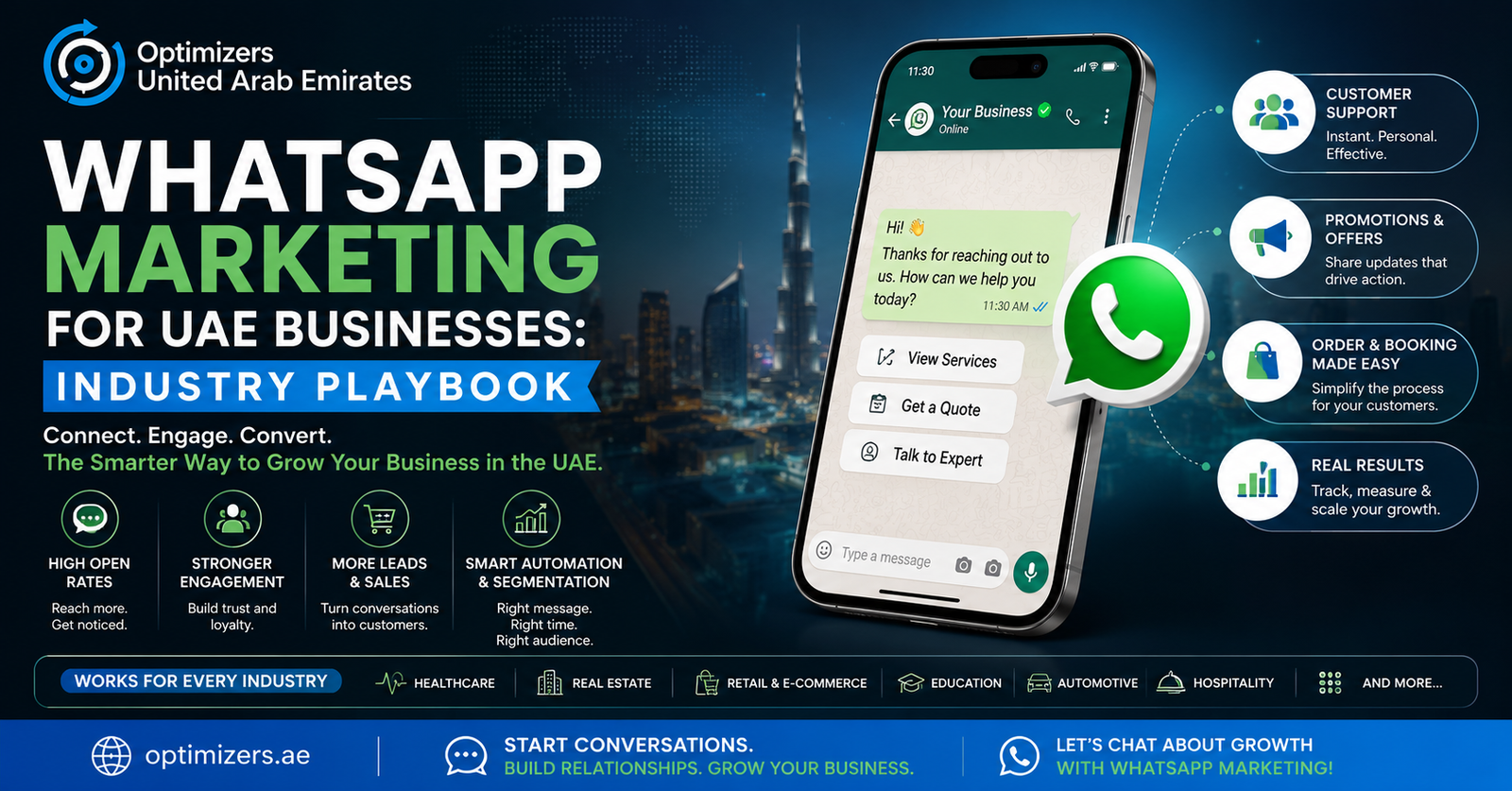
WhatsApp Marketing for UAE Businesses
If you are still treating WhatsApp as a support inbox instead of a sales channel, you are leaving revenue on the table. Industry surveys consistently put daily WhatsApp usage among UAE smartphone users at roughly 90 to 93%, higher than any other platform in the country. Customers in Dubai, Abu Dhabi, and across the Emirates now expect to discover a business on social media, check it on Google, and close the deal on WhatsApp.
This guide breaks down what actually works for UAE businesses in 2026: the real difference between the free app and the Business API, what compliant marketing under the UAE’s data protection law looks like, and a sector-by-sector playbook covering all ten industries we work with most, from real estate to legal and accounting services.
What is WhatsApp marketing for UAE businesses?
WhatsApp marketing is the practice of using WhatsApp, either through the free Business App or the Business API, to send promotional, transactional, and conversational messages to customers who have opted in. In the UAE, it functions as both an advertising channel and a direct sales channel, with conversion rates that consistently outperform email and standard landing pages.
| WhatsApp Business App | WhatsApp Business API | |
|---|---|---|
| Cost | Free | Per-message pricing through a Business Solution Provider |
| Broadcast Limit | 256 contacts per list, and only to contacts who have saved your number | No fixed cap, with templates approved in advance |
| Automation | Basic auto-replies and away messages | Full chatbot flows, drip sequences, CRM triggers |
| Team Access | Up to 4–10 linked devices depending on plan | Unlimited agents through a shared inbox |
| CRM Integration | None | Connects to HubSpot, Zoho, Salesforce, and similar tools |
| Best Suited For | Sole traders and businesses handling a handful of conversations a day | Any UAE business with real lead or order volume |
If your team is manually copying numbers into broadcast lists and hitting the 256-contact ceiling, you have already outgrown the free app.
Why WhatsApp converts better than almost any other UAE channel?
WhatsApp’s advantage comes down to attention and trust. Open rates on WhatsApp messages run close to 95 to 98%, compared with roughly 20% for email. Click-to-WhatsApp (CTWA) ad campaigns, where a Facebook or Instagram ad opens directly into a WhatsApp chat instead of a landing page, have reported conversion rates on the resulting sales conversations far above standard landing-page funnels in UAE case studies, with several agencies citing return on ad spend in the 3x to 8x range against 1.5x to 3x for landing-page-only campaigns.
The deeper reason this works in the UAE specifically is the shape of the buyer journey. A customer discovers a brand on Instagram or TikTok, searches Google to confirm it is legitimate, and then sends a WhatsApp message to ask the one question that decides whether they buy. That message is the highest-intent moment in the entire journey. If a competitor answers it and you do not, the sale goes to them regardless of how much you spent on the ads that got the customer there in the first place.
WhatsApp Business API pricing in the UAE
Meta prices the API by message category rather than by conversation, and rates are billed in AED once a Business Solution Provider has set up your account.
Marketing
AED 0.16–0.18
Promotions, broadcasts, new launches
Utility
AED 0.039–0.057
Order updates, appointment reminders
Authentication
AED 0.039–0.057
OTPs, login verification
Service
Free
Replies within the 24-hour window
On top of message costs, expect a monthly platform fee from your Business Solution Provider, typically in the low hundreds of AED for small accounts and scaling with conversation volume. Service messages being free is the detail most businesses underuse: if you can get a customer to message you first, every reply in the next 24 hours costs nothing.
UAE compliance: what the law actually requires
WhatsApp marketing in the UAE is fully legal, but it sits squarely inside the UAE Personal Data Protection Law — Federal Decree-Law No. 45 of 2021, in force since January 2, 2022. The law requires a clear, specific, and unambiguous opt-in before you message anyone for marketing purposes, and it gives customers the right to object to direct marketing and withdraw consent at any time.
In practice, this means:
- Capture explicit opt-in before adding any number to a broadcast list, through a website checkbox, a signed form, or a recorded verbal consent in your CRM.
- Offer a clear opt-out in every broadcast (“Reply STOP to unsubscribe”) and honor it immediately.
- Use a verified WhatsApp Business Account so customers can confirm you are who you claim to be.
- Work only through a Meta-authorized Business Solution Provider. Unofficial bulk-sending tools violate WhatsApp’s own terms and risk a permanent number ban, separate from any PDPL exposure.
One detail most generic compliance guide miss: personal health data is carved out of the PDPL and governed separately, under Federal Law No. 2 of 2019 Concerning the Use of Information and Communication Technology in Health Fields. Healthcare and clinic businesses running WhatsApp campaigns need to handle patient data under that law specifically, not the general PDPL framework.
Industry playbooks: what works by sector
WhatsApp strategy is not one-size-fits-all. Here is what we have seen work across the ten sectors we get asked about most.
Real estate
Leads pour in 24/7 from Bayut, Property Finder, and paid social, but a slow response kills intent within minutes. A WhatsApp chatbot that qualifies budget, timeline, and preferred area within seconds of lead capture, then routes the prospect to an agent or books a viewing automatically, keeps leads warm long enough to convert. Drip sequences delivering floor plans and payment plan PDFs over one to two weeks do the rest.
Healthcare and medical clinics
Missed appointments cost UAE clinics real money, and call-centre reminders are slow to scale. Automated reminders 24 hours and 2 hours before an appointment, paired with one-tap rescheduling, cut no-shows meaningfully. Bilingual Arabic and English intake bots handle new patient questions outside clinic hours, which matters in a market that runs around the clock.
E-commerce
UAE cart abandonment runs high, and email recovery sequences rarely pull back more than a few percent of lost sales. WhatsApp recovery messages, sent within an hour of abandonment, consistently outperform that. Order confirmations, shipping updates, and review requests sent through WhatsApp instead of email also keep the post-purchase relationship active, which is where repeat orders come from.
Hospitality, F&B, and tourism
Guests expect instant, personal service in their own language, something a call centre cannot match around the clock. WhatsApp concierge flows handle reservation confirmations, room upgrade offers, and checkout reminders, while post-stay messages collect reviews and push loyalty offers without needing a human on every shift.
Beauty and wellness
Salons and clinics lose chair time to no-shows and last-minute cancellations more than almost any other service business. Automated booking confirmations and reminders, paired with a simple WhatsApp rebooking flow sent right after a visit, fill gaps in the calendar that would otherwise sit empty. Before-and-after photo sharing and loyalty point updates through WhatsApp also build the personal relationship, this category depends on.
Education
Parents and prospective students want fast, direct answers, not a contact form that gets a reply in three days. Admission query bots can answer common questions instantly and hand off to staff for anything specific, while class reminders and fee payment alerts sent over WhatsApp consistently get read faster than the same notices sent by email.
Automotive
Test drive bookings and service reminders are the two highest-value WhatsApp use cases for dealerships and garages. A simple booking bot for test drives, combined with automated service-due reminders tied to a customer’s last visit, keeps both new sales and the service department’s calendar full without extra staff time.
Business setup services
Company formation enquiries in the UAE come with a lot of back-and-forth: free zone comparisons, licence types, visa quotas. WhatsApp lets a consultancy answer those questions conversationally and share documents (cost breakdowns, checklists) instantly, which shortens what is often a multi-week decision cycle.
Legal and accounting services
These are relationship-driven, high-trust services where clients expect a quick, personal response to a contract question or a tax deadline reminder. WhatsApp works best here as a structured update channel — milestone notifications, document requests, deadline reminders — layered on top of the more formal email and call relationship rather than replacing it.
IT and SaaS companies
For B2B software and IT service providers, WhatsApp shines as a faster proposal and support channel than email. Automated onboarding sequences, renewal reminders, and a direct line for technical support questions reduce the back-and-forth that typically stalls a sales cycle or a support ticket.
Seven WhatsApp strategies worth building first
01
Click-to-WhatsApp ads
Run the ad on Instagram or Facebook, skip the landing page, and let the customer start the conversation directly. The first reply window after a CTWA click is free of conversation charges, which makes this one of the cheapest high-intent channels available.
02
Opted-in broadcast campaigns
Promotions, launches, and event invitations sent to a clean, consented list. Treat your broadcast list like an email list, not a group chat.
03
IT and SaaS companies
For B2B software and IT service providers, WhatsApp shines as a faster proposal and support channel than email. Automated onboarding sequences, renewal reminders, and a direct line for technical support questions reduce the back-and-forth that typically stalls a sales cycle or a support ticket.
04
Bilingual AI chatbots
Arabic and English flows that qualify leads, answer FAQs, and hand off to a human only when needed, available outside business hours.
05
Drip nurture sequences
A scheduled series of value-adding messages after someone opts in, most effective for real estate, B2B, and any purchase that takes more than one conversation to close.
06
Customer support automation
Deflect routine questions, order status checks, and FAQs to an automated flow so your team only handles the conversations that need a human.
07
Post-purchase and loyalty flows
Confirmations, delivery updates, review requests, and loyalty point notifications that keep the relationship alive after the sale closes.
Mistakes that get UAE WhatsApp accounts restricted or ignored

Messaging without opt-in
The fastest way to a spam-blocked number and a PDPL problem in one move.
Using unofficial bulk-sending tools
These violate WhatsApp’s terms directly and risk a permanent ban regardless of how the messages are received
Over-automating the sales conversation
Customers in the UAE expect a personal touch once a conversation gets specific. Use automation for the first response and handoffs, not for closing.
Letting the 256-contact limit go unnoticed
Businesses that outgrow the free app and keep using it simply stop reaching a growing share of their own customer list.
Sending the same message to every emirate and every language audience
A broadcast that ignores Arabic-speaking customers and treats Dubai and Sharjah identically leaves easy wins on the table.
Frequently asked questions
Yes. WhatsApp marketing is fully legal under the UAE Personal Data Protection Law (Federal Decree-Law No. 45 of 2021), provided you obtain explicit opt-in consent before sending promotional messages and offer a clear way to opt out. Using a Meta-authorized Business Solution Provider also keeps you compliant with WhatsApp’s own terms of service.
The free Business App is built for low-volume use, capped at 256 contacts per broadcast list and limited to basic automation. The Business API removes that cap, adds full chatbot and CRM integration, and is the only realistic option for any UAE business handling meaningful lead or order volume.
API pricing depends on message category: marketing messages run roughly AED 0.16 to 0.18 each, utility and authentication messages run AED 0.039 to 0.057, and service messages within the 24-hour reply window are free. A Business Solution Provider’s monthly platform fee sits on top of these per-message costs.
Yes, particularly for appointment reminders and rescheduling, which directly reduce no-shows. Healthcare businesses need to handle patient data under Federal Law No. 2 of 2019 on ICT in Health Fields specifically, in addition to general WhatsApp opt-in requirements, since health data sits outside the general PDPL.
It depends on your audience, but it is rarely a bad investment. Businesses operating in Abu Dhabi and Sharjah, where Arabic-speaking nationals make up a larger share of the customer base than in Dubai’s expatriate-heavy market, typically see the strongest return from bilingual chatbot flows.
WhatsApp in the UAE has moved past being a nice-to-have support channel. It is where discovery turns into a sale. The businesses getting real customers out of it, not just message volume, share three habits: a properly consented contact list, an API setup built on a real Business Solution Provider, and message flows built around each sector’s actual sales cycle rather than a generic broadcast template.